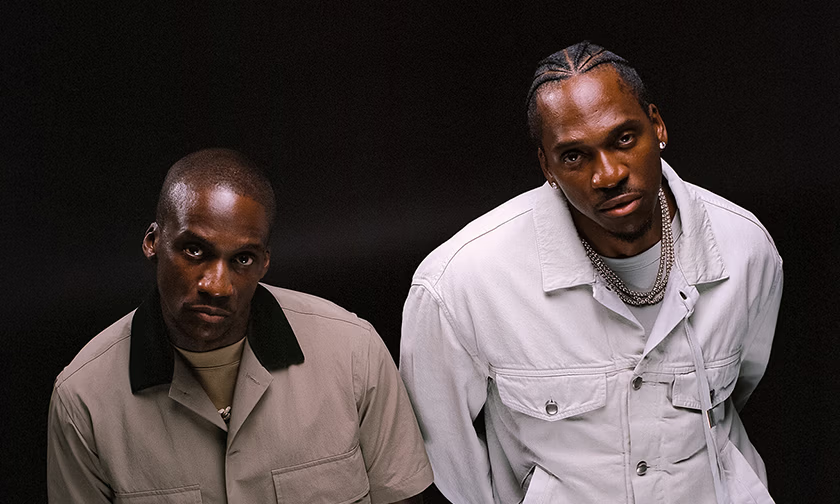
The Chemical Brothers: Tickets for Events
The most important information about The Chemical Brothers
If you're hoping to catch The Chemical Brothers tickets, you're looking at one of British electronic music's most enduring and influential partnerships.
If you're hoping to catch The Chemical Brothers tickets, you're looking at one of British electronic music's most enduring and influential partnerships. Formed by Tom Rowlands and Ed Simons, the duo have spent decades reshaping what dance music can sound like on record and feel like in a crowd, and their reputation as pioneers of big beat remains a defining thread in their story.
The Chemical Brothers – musical style
There's a physicality to The Chemical Brothers' sound that sets it apart from much of its electronic peer group. Where some producers favour subtlety, Rowlands and Simons have always leaned into scale: enormous breakbeats, swirling psychedelia, basslines that seem to press against the chest. This is music built for impact, and it's no accident that the duo became synonymous with the big beat movement, a style that fused hip-hop's breaks with rave's intensity and rock's swagger into something defiantly maximalist.
Yet reducing their work to genre tags undersells the texture running through it. Listen closely and there's a psychedelic sensibility threading through even their most dancefloor-focused tracks, a sense of samples and sounds warping and bending as though the music itself were in motion. It's a quality that rewards attention as much as abandon, giving their records a strange durability: tracks that worked in sweaty clubs decades ago still sound vital played loud today.
Collaboration has long been part of the fabric too. The Chemical Brothers have shown a willingness to bring outside voices into their world rather than treating their productions as closed systems, pairing their electronic architecture with guest vocalists whose own identities bend to fit the Brothers' sonic universe without ever being swallowed by it. That openness has given their catalogue an emotional range beyond pure instrumental intensity, moving from euphoric to melancholic to outright strange within the span of a single record.
There is also a storytelling instinct at work, albeit one told through texture rather than lyric. Builds and drops function almost like narrative devices, tension accumulated and released with a craftsman's patience. It's a style attentive to the architecture of a track from first second to last, something that separates a Chemical Brothers production from simpler dance music built around a single hook.
Underpinning all of it is a restless curiosity, a refusal to simply repeat what worked before. Across their catalogue, you can trace a group testing the edges of what big beat and electronic music more broadly could hold, absorbing new textures and ideas while keeping their core identity intact. That combination of consistency and reinvention is part of what has allowed their music to remain relevant across such a long span of time.
Key career highlights
The Chemical Brothers' story began, fittingly, with a gesture of homage. Early on, Rowlands and Simons recorded under the name The Dust Brothers, a nod to the American production duo of the same name. It didn't sit well with everyone, and the pair rebranded as The Chemical Brothers — a choice that, in hindsight, feels inseparable from the music itself, chemical reactions being as apt a metaphor as any for what they do to a room.
What followed was a body of work remarkable for its sheer scale. Across nine albums, the duo have built a catalogue that has sold more than 13 million copies, with their singles pushing sales close to 20 million — numbers that place them among the most commercially significant acts electronic music has produced. Streaming figures tell a similar story of longevity, with their music streamed in excess of 3 billion times, a figure that speaks to catalogue depth as much as any single hit.
One particular landmark came with the album Come With Us, a record that showcased the duo's gift for collaboration as much as production. Featuring Richard Ashcroft delivering one of his most impassioned vocal turns and longtime collaborator Beth Orton lending her distinctive voice to a folk-tinged, melancholic highlight, the record demonstrated the breadth of emotional territory the Brothers were willing to explore even at the height of their big beat reputation.
Taken as a whole, the journey reflects an act operating at the intersection of credibility and scale — a duo capable of filling festival fields while remaining, in the eyes of critics and peers alike, one of the most influential groups in electronic music history. Few acts manage both; fewer still sustain it across the decades The Chemical Brothers have been active.
A few verified milestones stand out clearly from that journey:
- A rebrand from The Dust Brothers to The Chemical Brothers early in their career
- A catalogue spanning nine studio albums
- Combined album and single sales reaching well into the tens of millions
- Streaming totals surpassing 3 billion plays
- A landmark collaborative album in Come With Us, featuring Richard Ashcroft and Beth Orton
The Chemical Brothers – live shows
There's a reason The Chemical Brothers' live reputation looms as large as their recorded output. Electronic music can sometimes struggle to translate from studio to stage, but this is a duo whose material seems almost designed for the communal charge of a crowd — tracks built around the slow tightening and sudden release of tension, the kind of structure that turns a room full of strangers into something closer to a single, breathing organism.
Walking into one of their shows, you sense immediately that this isn't background music. The scale of sound meets a visual intensity that wraps around the audience, turning a gig into something closer to total immersion. It's the sort of environment where a familiar track can feel newly overwhelming, reshaped by the volume, the lighting, the physical presence of thousands of people responding to the same pulse at once.
What lingers afterwards isn't just the memory of specific songs but a feeling — of euphoria earned through sustained build, of a night that moved through distinct emotional phases rather than simply delivering one note throughout. That's the particular gift of a well-run Chemical Brothers show: it understands pacing, understands patience, and trusts its audience to go on that journey rather than demanding instant gratification.
For newcomers and longtime followers alike, there's something genuinely levelling about experiencing this music live. It doesn't require deep familiarity with the back catalogue to feel its pull; the physicality of the sound does most of the work, drawing people in regardless of how they arrived at the music in the first place.
Tickets for The Chemical Brothers on FanTix
Booking through FanTix is designed to be as straightforward as the occasion deserves. The purchase journey has been kept simple and clear from start to finish, so you can move from browsing to booking without unnecessary friction or confusion along the way.
Every transaction runs through a secure checkout, giving you confidence that your details and your purchase are properly protected throughout. Once your booking is complete, your tickets are stored directly in your FanTix account, meaning there's no need to worry about paper copies or searching through emails when the time comes.
For those planning to make a night or a trip of it, FanTix also offers the option to arrange accommodation on the same platform. It's a practical addition for anyone looking to sort travel logistics alongside their tickets, keeping the planning process in one place rather than scattered across multiple sites.
Altogether, it's an approach built around convenience and reassurance — a booking experience that stays out of your way, so the focus can remain on the music itself.